The Clothes Make the Woman: on Dress, Class, and Adapting Austen

Photo by Héctor J. Rivas on Unsplash

If there’s one thing that romance has in abundance, it’s Austen retellings. Specifically, Pride and Prejudice retellings. Which is why I was extra delighted to pick up Camille Kellogg’s modern sapphic take on P&P, Just As You Are, and find that it breathed some new life into familiar romance territory. Reading this text also got me thinking more broadly about what makes a successful retelling. What does it entail, besides repurposing plot beats and character dynamics? How can a good retelling balance innovation and faithfulness to the original? And what does adaptation tell us about how readers relate to the fictional worlds they read? So that’s today’s topic.

The spoiler level here today is very low, so feel free to read on even if you haven’t (yet) picked up Kellogg’s delightful book. Here’s some basic info:

Liz Baker and her three roommates work at the Nether Fields, a queer magazine in New York that’s on the verge of shutting down—until it’s bought at the last minute by two wealthy lesbians. Liz knows she’s lucky to still have a paycheck but it’s hard to feel grateful with minority investor Daria Fitzgerald slashing budgets, cancelling bagel Fridays, and password protecting the color printer to prevent “frivolous use.” When Liz overhears Daria scoffing at her listicles, she knows that it’s only a matter of time before her impulsive mouth gets herself fired.
But as Liz and Daria wind up having to spend more and more time together, Liz starts to see a softer side to Daria—she’s funny, thoughtful, and likes the way Liz’s gender presentation varies between butch and femme. Despite the evidence that Liz can’t trust her, it’s hard to keep hating Daria—and even harder to resist the chemistry between them.
This page-turning, sexy, and delightfully funny rom-com celebrates queer culture, chosen family, and falling in love against your better judgment.

More info on the book here

What’s often missing from P&P retellings – and what Kellogg’s book gets very right – is the complicated relationship between social class, respectability, and desire. Retellings of Austen’s classic will usually show that Darcy is rich and Lizzie is not; they will often present Lizzie as lacking a certain social polish and Darcy as a grump, and these differences of temperament will somewhat get in the way of their romance. But really, it’s the socially conditioned relationship between these elements that matters most: the era, milieu, and moment that Lizzie and Darcy live in allow them (and the reader) to understand subtle class-based cues about what is seen as respectable, which in turn affects how they judge their own and others’ desirability as a partner. This relationship plays out in Just As You Are rather cleverly, through its treatment of clothing and gender expression among sapphic women in modern New York City.

By focusing on how Just As You Are uses clothing, I don’t mean to suggest that’s the only place where class and conformity and desire show up in this book (or, for that matter, in other Austen retellings: I would be remiss not to mention Fire Island as another very different take on P&P in specifically cis gay male social circles). But I think the way clothing, in particular, allows Kellogg’s novel to explore the nexus of gender, wealth, social pressure, and desire is really unique. And can probably be best explained through a close reading of a single scene: in which our heroine Liz (Elizabeth Bennett!) has dinner with her boss Daria (Darcy!), Daria’s uptight rich aunt Katherine (Lady Catherine de Bourgh!) and Daria’s ex-girlfriend Caroline (Caroline Bingley!)

To set the scene: Liz is on a work trip to Boston to conduct an interview. She has a job in NYC writing about sex and intimacy and other non-“respectable” topics for the queer online magazine Nether Fields. Accompanying her is Daria, joint-owner and investor in the struggling online magazine. This work trip ends up involving an unannounced trip out for dinner to celebrate the birthday of Daria’s aunt Katherine. The dinner party is – as anything involving a stand-in for Lady Catherine de Bourgh must be – absolutely excruciating. Especially when Daria’s ex Caroline shows up.  But before we get to that, let’s take a quick look at what everyone’s wearing over the course of the scene:

Katherine (before dinner):

She was white, with gray hair pinned into an elaborate bun. She wore a creamy, expensive-looking scoop neck blouse with a string of pearls and a navy cardigan despite the summer humidity.

Katherine (for dinner):

Katherine came into the room, wearing a conservative turquoise dress with a gray shawl.

Daria:

Daria was wearing a gray, tight-fitting suit with a white shirt and a red tie with a matching pocket square. 

Caroline:

She was wearing a silver dress that plunged at the neckline- Liz had to focus to keep herself from looking too closely at her cleavage. Her hair was blown dry, her makeup was impeccable, and her nails matched her dress. Liz hated her.

Liz (before dinner):

She was wearing industrial-looking gray work pants and a black T-shirt with her black Doc Martens. It was more butch than Liz’s usual taste, but the outfit gave her a bit of swaggering confidence that she thought would help with the interview. She hadn’t considered that she’d be meeting Daria’s aunt in her outfit choice. 

Liz (for dinner);

At six forty, Liz went downstairs. She was wearing the most femme outfit she’d brought – tight black jeans and a button-down shirt. She had a feeling that Daria’s aunt would have preferred a dress, but Liz hadn’t thrown a lot of fancy dining options into her bag. 

So obviously, there’s a lot going on here. First, and perhaps most apparently, is the fact that Daria, Caroline, and Katherine all wear clothes with markers of wealth – silver, fitted, expensive-looking clothes, with pearls or a matching tie and pocket square – that are socially appropriate for a dinner party. Liz, in both instances, is dressed in a way that reads too casual, but she doesn’t have access to the supposedly-appropriate clothing: both immediately, because she didn’t pack it, and more generally, because she can’t afford it as a writer for a small online magazine living in New York City.

 What interests me the most, though, is the way that wealth works along with gender to code the respective “appropriateness” of each of these outfits. Daria and Caroline – both queer women – are dressing themselves within gender-binary models. Caroline subtly echoes Katherine’s “rich white lady look”: trading a cream scoop-neck blouse for a silver plunging neckline, an elaborate bun for an equally time-consuming blow-out. High femme, high cost, and high maintenance. Daria, in turn, is dressed along traditionally masculine lines in a suit and tie: likely bespoke, given the fit. There’s an interesting backstory to this aspect of Daria’s personal style. A couple of chapters earlier, she talks about going into finance because she wanted to dress like the men who worked in that sector, and to command respect the way they did. Yet she lacked female models (like Caroline has in Katherine) for how to do so. Thus she’s ended up in a financially lucrative, respectable, and male-dominated job, which has enabled her to express her gender identity in a way that feels right to her, and is – at least comparatively – read as “right” for a dinner party, conforming as it does to previously established binary forms of dress. Though this sartorial emulation is, of course, not without its difficulties and emotional costs. 

Placing Liz on this axis – where both personal wealth and proximity to gendered models of expensive dress allow Daria and Caroline to meet societal expectations – produces some really interesting results. Liz indicates throughout the book that she doesn’t feel at home in either femme or masc clothing, and instead moves fluidly between the two. This is not just experienced by Liz as an identity crisis, but also as a financial one: it requires her to have two separate wardrobes, and to be able to bring two sets of clothing with her wherever she goes. The only piece of individual clothing that feels androgynous enough on its own is an expensive blazer gifted to Liz by her problematic crush Weston (Wickham!), once again asserting how much money is tied up in both social “acceptability” and self expression in the world of this novel.

This level of specificity is, for me, what makes Just As You Are so successful as a Pride and Prejudice retelling. Communicating that Elizabeth and Darcy are operating in a broader social and economic structure that dictates how they present themselves, how others see them, and how they see themselves is obviously important, but so is the fact that said structures are quietly expressed through small details. Like any other kind of world-building, creating this structure through clothing in a modern retelling of P&P means paying attention to details that are appropriate to the universe the characters live in, as well as ensuring that they’re legible to modern readers. 

When it comes to good retelling, of course, there’s a question not just of similarity to the original, or transposition of its primary themes, but also significant differences. This, I think, is where the question of “desire” comes into play, and how it works in an Austen novel vs. a contemporary queer romance. In Austen’s original, a primary function of desire relies on the marriage plot: wealth and respectability combine to create the conditions for a desirable marriage. Which isn’t to say that Lizzie and Darcy’s romantic desire for each other doesn’t matter, but rather that “desirability of marriage” remains an important external element pushing events along. Part of the reason Elizabeth Bennett’s social class standing matters is that it represents a significant impediment to romance, because making an advantageous and socially acceptable marriage remains crucial in the world of the novel.

That’s always been one element of the original text that, to my mind, has a difficult time making the leap to contemporary romance. I don’t mean to imply that class pressures and ideas of respectability don’t play into our understanding of a desirable marriage in 2024, but they do differ meaningfully in both intensity and scope from Austen’s day. For Daria to be sympathetic to modern readers, she rightly isn’t shown as placing Austen-levels of weight on social class or gender expression when it comes to who she wants to date. (Side note: Liz’s job writing listicles about sex toys for an online magazine does some of the “respectability” work here, in ways that dovetail really nicely with a broader exploration of the value of pleasure, including in romance novels themselves.) However, when it comes to the main theme of this blog post – how social class relates to gender and desire – Kellog’s novel is interested less in whether Liz will be desirable to Darcy for those reasons, and more interested in how Liz desires to live in the world and express herself. Liz figuring out how to express gender through clothing, and accept herself despite society’s strictures, is a journey of personal desire, and brings some entirely new material to Austen’s classic. 

It’s this addition of a modern queer take on gender expression that keeps this novel feeling fresh, and in dialogue not just with Austen, but also with its contemporaries. I would posit that Austen’s novels are concerned with the collective, the external, and the social to an extent that differs from current romance novels, which tend to place a comparatively heavier emphasis on internality and individual identity expression. The fact that Liz’s clothing also represents a personal journey towards accepting her own gender expression – one that exists outside of what anyone else in the novel feels about it – is not a whole-cloth (see what I did there?) addition to Austen’s novel, but rather a subtle shift in emphasis that brings Just As You Are in line with current trends in contemporary romance. Of course, whether the shift away from the collective and towards individuality is itself a product of late-stage capitalism, and thus still related to class issues, is probably a topic for another post! In any case, the novel speaks to modern readers not just because it draws our ability to discern the varying levels of appropriateness of a scoop-neck dress, a tailored women’s suit, and a pair of jeans at a dinner party. It also speaks to what we look for in queer romance in 2024, including strong individual growth arcs and sensitive explorations of gender identity. Which makes Just As You Are a very successful retelling indeed. 

What’s in a genre? Two book recommendations and some thoughts on defining romance

https://unsplash.com/photos/brown-wooden-book-shelves-in-a-library-Zqmia99hgF8?utm_content=creditShareLink&utm_medium=referral&utm_source=unsplash

Hello! Its been a while since I wrote – almost a year, to be exact, and in that time, I’ve been thinking a lot about what I want to do with this blog. I’m still reading romance, but I’ve also been branching out into other genres that live nearby, and some of those books are what I’ve most been longing to write about. But, you know, it says “Close Reading Romance” on the masthead of this thing, and I wasn’t sure exactly how that would fit. Or, for that matter, what to do with my desire to also write some pieces that focus less on prose, and more on Big Genre Musings like “What does it mean to read for pleasure?” and “What is ‘no plot, only vibes’ doing for readers?” and “What’s happening when we say some books with HEAs still aren’t romances?” And then, as a very smart friend reminded me, this is my blog and I can do what I want! So, I’m not going to stop doing close readings. And I’m definitely not going to stop writing about romance. But I might use this space to do some other things too, and today’s post is (sort of) one of those other things. 

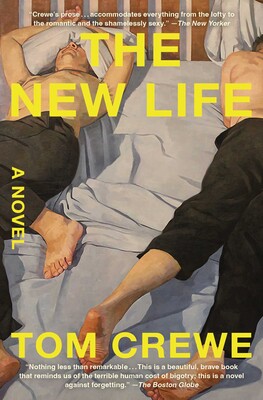
Basically, the two recent reads that I most want to press into the hands of everyone I know with a wild look in my eye… are not genre romances. But I came away feeling like they each had, in their way, the soul of a genre romance. Or, at least, that they rewarded a reading that searched for that soul. The books in question are Siren Queen by Nghi Vo, and The New Life by Tom Crewe. I want to tell you about those books – and without spoiling too much, about why you might want to pick them up if you’re a romance reader  – and then talk about why I’m increasingly skeptical about strict divisions between genres. So, without further ado, a little bit about the best two books I’ve read so far this year, and how their writing makes them tick.

Siren Queen by Nghi Vo

More info on Siren Queen here.

My short pitch for Nghi Vo’s Siren Queen is that if you’re a reader who doesn’t love complicated and strange world-building, this book could change your mind. Gorgeous prose and masterful story-telling help readers experience the power and sometimes horrible beauty of this fantasy world without needing to fully understand its rules: it’s the difference between experiencing a new country by visiting it and tasting all its sensory delights, and taking a pop quiz on its history. The first sentences of the book ask the reader to follow the narrator into the unknown:

Wolfe Studios released a tarot deck’s worth of stories about me over the years. One of the very first still has legs in the archivist’s halls, or at least people tell me they see it there, scuttling between the yellowing stacks of tabloids and the ancient silver film that has been enchanted not to burn.
In that first story, I’m a leggy fourteen, sitting on the curb in front of my father’s laundry on Hungarian Hill.

This passage suggests a certain fluidity between what is and isn’t real. My instinct is to read the second sentence as starting with a metaphor (stories that “have legs” and “scuttle” around tabloids) and moving to a literal description of a fantasy-genre world (film that has been “enchanted not to burn”). However, the narrator, for all intents and purposes, treats these two elements as equally real. Nothing is over-explained: the “tarot deck’s” worth of stories is also a disorienting image, as tarot isn’t commonly understood to be read for stories so much as for information about the future. 

The difference between metaphor and reality, between reading for story and reading for future understanding, is all the tension of this book. It’s the story of Luli Wei, an actress in a version of old Hollywood where magic is real, and so are monsters, and where becoming a “star” is both Luli’s cinematic goal and a literal thing that happens to immortal Hollywood actors. Because this story thrives on the liminal spaces of uncertainty – you never learn the backstory of a number of the fantastical elements of this narrative – the moments where the narrator offers reassurance to readers are all the more meaningful. She does so at the end of the above passage, for example, by telling readers that the story of her fourteen year old self is “bullshit, of course.” Luli has the real story, a key element to building narrative trust. There’s one other major thing that Siren Queen structurally reassures the reader about. This, from page 20: 

Even with it all, the money, the crackling atmosphere of the set, the kiss Maya Vos Santé had given me, I might never have longed for a star of my own and a place high in the Los Angeles sky. I don’t know what else might have happened to me; I was too young when it all began, and I hadn’t shown the twists and hooks that would have drawn other fates to me.
(“Oh, you were always meant to be in movies,” Jane said. “One way or another, you would have found your way in, no matter what was standing in your way.” 
“Is that a compliment?” I asked her. 
“It’s better than a compliment, it’s the truth.”)

Interspersed throughout the novel are these parenthetical asides between Luli and a woman named Jane, clearly a romantic partner. Luli loves a number of women throughout the story – the mercurial and beautiful actress Emmaline, and a firecracker of a screenwriter named Tara – and while neither of these women end the story in a romantic relationship with Luli, they are integral to her story. Jane only appears in these asides, and a particularly emotional mention in the epilogue. 

The presence of each of these love stories is probably enough to appeal to the romance reader: they’re each compelling and gorgeously-written. But the inclusion of the Jane asides, for me, goes beyond the simple presence of a love story that ends happily. By making it clear that Luli is telling this story to a lover, Siren Queen emphasizes the value of allowing readers to start a story already knowing that love survives- a fact that particularly stands out when so little else is fully known and understood. This is particularly important when it comes to queer love stories in the kind of hostile outside world in which Siren Queen is set. Luli lives in a universe where her love affairs with women have to be kept from predatory and prejudiced studio executives. They are never, however, kept from the eye of the reader. Whether it’s the sparks of Luli’s first meeting with Tara, the beautifully rendered sex scenes with Emmaline, or (especially) the HEA-infused asides with Jane, the importance of queer love is one of the most concrete things in this confusing world. Without necessarily being a romance, this book has a lot to say about the value of a love story that is more legible to the reader, right from the start, than the magic, the history, the monsters, and the stars of the universe.

The New Life by Tom Crewe

More info on The New Life here.

The question of what is said and what isn’t also makes for an interesting romance-informed reading of The New Life by Tom Crewe. Like in Siren Queen, there is a clear love story between two characters which ends optimistically: in this case, it’s between John Addington, one of two men in 1890s England writing a controversial book in defense of homosexuality, and his lover Frank. But it’s the second main character of the story, John’s writing partner Henry, who ended up being one of the most fascinating characters in my recent reading memory. Henry is incredibly opaque to himself and to the reader, especially when it comes to desire. He is married to Edith, but they do not have a sexual relationship: Edith has a lover named Angelica, and the contours of what Henry wants from his marriage – or from outside of it – aren’t always clear to himself or to others. Yet together with John, he is preparing to take on the risk of publishing a book arguing for the decriminalization of homosexuality, right as the Oscar Wilde trial is gripping the nation. 

Part of Henry’s opacity comes from how he’s constructed through the novel’s prose, as in this passage where he is about to interview his friend Jack, as part of a set of anonymized oral histories of gay men collected via survey for his book. 

He was not made by Jack to feel like an oddity, as though what feelings he had were irredeemably childish and virginal for not being roughly expressed. He never wondered about Jack’s quietness. He was not then in the habit of thinking about other people. It was not that he didn’t care – with the exception of Edith, he had never cared for anyone so much as he did for Jack at that time – only that he saw other people purely as they presented themselves to him, as if he were a backcloth receiving a projection and this was his sole purpose, to show them to themselves. 

The writing of this novel has, at times, an incredible restraint to it. If Siren Queen offered an opulent surfeit of things said without needing to be fully understood, The New Life is all about what is not said, yet which still demands understanding. Henry’s interpretation of himself as a “backcloth receiving a projection” is echoed in the prose, which suppresses active agency in favor of more circumspect or passive-voiced formulas (“he was not made by Jack to feel”/“as they presented themselves to him”). In a passage that directly follows this one, Henry’s wife Edith chastises him for not asking about his best friend’s love life in the course of their interview: 

She bent her head back, squeezing her eyes shut. “You realize you didn’t ask, whether he has someone.”
“That is not one of the questions.”
“I know.”
“Should I have done?”
“Oh, Henry,” she said. “Yes, you should.” 

For one of the most moving passages of the novel, the prose is spare, stripped even of dialog tags except where necessary. The chapter ends abruptly after these lines, and the reader is left with the work of understanding why Henry has not asked his friend about a partner, what it would have meant to Jack to be asked, and why that’s something Edith can understand, but not her husband. 

What I found the most fascinating about Henry is that as a romance reader, I kept trying to classify him in terms of his desire. Was he straight, queer, an “ally,” someone who didn’t know what he wanted in a sexual partner, who preferred non-sexual intimacy, who preferred self-pleasure over partnered sex? By the end of my reading, I might have said that none of these things were true, or that many of them were a little true, along with other unexpected truths. But what most struck me, as I read, was realizing how much romance has trained me to read character through desire. Encountering a character who resisted that reading was intriguing, both in terms of narrative arc and prose. Yet at the same time, Henry is surrounded by legible romantic desire- his wife’s desire for her lover Angelica, his writing partner’s desire for Frank – and it is his proximity to, and examination of, those forms of romance that eventually helps him understand his own relationship to desire (slightly) more clearly.

Coming to a deeper understanding of oneself by encountering narratives and impressions of others’ desire perhaps probably resonates with how a lot of us feel as we read romance: in some ways Henry resists a romance reading while also performing one on those around him. Which is an interpretation of this book that wouldn’t have been available to me if I wasn’t coming to it with my specific genre lens. The New Life contains both a distance and a proximity to romance that are in constant tension- and much like the “backcloth” that Henry evokes in the first passage above, a knowledge of genre romance reflected The New Life back to me a little differently than it might to other readers.

What’s in a genre?

It occurred to me, while writing about these books, that a shorthand I might use to tell romance readers that they would enjoy Siren Queen and The New Life would be: “they’re not romances- they have love stories that end optimistically, but there isn’t a central focus on one love story.” And for these two books, that’s a) very true and b) not necessarily news to anyone who picks them up. Both books are being marketed in other genres that fit them better (and, not to open a giant can of worms, but at least in the case of The New Life, genres that have drastically more cultural cachet than romance).  But… at the same time, what happens to other books that we say this about? Books that are being marketed, and received by some readers but not by others, as romance? Because “it ends happily but I didn’t feel like the love story was the central focus” is a way I’ve seen many books discounted from the genre: often, not coincidentally, when they feature MCs who are marginalized and whose personal growth arcs (alongside their love stories) are making important interventions in the genre. Placing a book inside or outside a genre produces meaning : it can set expectations, empower readers to find what they want, and situate a book in a wide literary universe. But it can also bring in biases that have little to do with narrative codes. If we’re skeptical towards claims that a personal growth narrative is “litfic” if it’s written by a man and “women’s fiction” if it’s written by a woman (just to cite one broadly-sketched example), it might also be worth a helping of skepticism towards claims that there’s a quantifiable amount of focus on an individual character’s growth, or depiction of personal hardship, or a particular relationship shape that automatically disqualifies a book from being read as a romance. 

Which isn’t to say that I think we shouldn’t be having those conversations as readers! On the contrary, I think a more flexible understanding – not necessarily even of “genre romance” but of “genre” itself – would leave a LOT more room for reader interpretation and agency. In the course of doing some reading for my day job, I came across a definition of genre that felt more promising to me in this regard. I first encountered it in this book (though it appears to come to Rieder via Paul Kincaid), and it suggests that we can think of a genre as “a group of objects that bear a ‘family resemblance’ to one another rather than sharing some set of essential, defining characteristics.” This appealed to me quite a lot. What if, instead of talking about books having a binary “in or out” relationship to a genre, we were able to talk about how much family resemblance they bore to other books we love? It may be a bit slipperier, because signs of “family resemblance” are varied enough that they can’t be exhaustively enumerated or defined ahead of time. But that slipperiness also means that I, as the reader, have to look for those signs of resemblance as I read: to seek out the early reassurance of an HEA in Siren Queen and the use of desire to create character in The New Life. And then I get to talk about what I found, creating an understanding of genre that’s collaborative, open, done from the ground up. So while I’m not necessarily advocating that we dissipate the definition of a genre beyond functionality (I’m not advocating anything, really, I still want to be able to find my HEAs!) I do think that the idea of a search for family resemblance executes a shift from reading “genre romance” to reading “as a genre romance reader.” Which, at least in the case of Siren Queen and The New Life, actively enriched my experience of both books. 

Anyway, I hope that, if nothing else, these ramblings encourage you to pick up one or both of these books. And, if you’re so inclined, I’d love to hear recommendations in the comments for other books you think can be read more richly with a romance genre lens.  

In Conclusion Part 4: Ander & Santi Were Here by Jonny Garza Villa

This post is the fourth and final close reading of “In Conclusion: A Four-Part Series on Epilogues and Endings in Queer Love Stories.” Before you read any of the posts on specific books, I’d recommend having a look at the introduction to the series first. Part 1 analyzes Something Spectacular by Alexis Hall, Part 2 Even Though I Knew The End by C. L. Polk, and Part 3 We Could Be So Good by Cat Sebastian- I’d only recommend reading those if you’ve already read the books. Happy reading!

Ander & Santi Were Here is a recently-published YA romance novel that has left an incredible impression on me. It tells the love story of Ander – a talented muralist who is about to head off to their first year of art college – and Santi – a new employee at their family’s restaurant. It starts as a sweet, summery teen romance, which quickly develops much more serious stakes as Ander learns that Santi is undocumented and living under threat of deportation. The journey that Ander and Santi take, standing up for the rights of undocumented people and carving out a space for their own love, is one of the most memorable stories I’ve encountered in this genre in a long time. It also offers a fascinating chance to look at the politics of queer utopias. Here’s the cover and blurb: 

The Santos Vista neighborhood of San Antonio, Texas, is all Ander Lopez has ever known. The smell of pan dulce. The mixture of Spanish and English filling the streets. And, especially their job at their family’s taquería. It’s the place that has inspired Ander as a muralist, and, as they get ready to leave for art school, it’s all of these things that give them hesitancy. That give them the thought, are they ready to leave it all behind?
To keep Ander from becoming complacent during their gap year, their family “fires” them so they can transition from restaurant life to focusing on their murals and prepare for college. That is, until they meet Santiago Garcia, the hot new waiter. Falling for each other becomes as natural as breathing. Through Santi’s eyes, Ander starts to understand who they are and want to be as an artist, and Ander becomes Santi’s first steps toward making Santos Vista and the United States feel like home.
Until ICE agents come for Santi, and Ander realizes how fragile that sense of home is. How love can only hold on so long when the whole world is against them. And when, eventually, the world starts to win.

Cover image and blurb from the author’s website. CW at Leigh’s review here.

This novel sets itself a fairly thorny issue for its denouement: how to end the love story on romance’s required hopeful note, without giving readers the false impression that the threat of unjust deportation is one that can be easily avoided. Part of the praxis of this novel’s conclusion is that it has to be hard-won, has to involve a sacrifice that attests to the ongoing injustice of US immigration policy. Garza Villa accomplishes this by having Ander decide to give up their plans for art school (already shown to be a place where institutional investment in whiteness would have been hostile to them as a person and as an artist), leave their family behind in Texas, and move to Mexico to start a new life with Santi. The epilogue starts with the three words “My Mexican Heaven,” and describes the peace and joy of the couple’s life together. Here’s the very last passage:

Falling asleep with Santi resting on me. A small pool of drool forming on my chest. My hand slowly rubbing his head. A bedroom made even more stuffy from everything we’ve spent the past hour doing. Knowing that tomorrow we get to do this all over again. 
Having all the time in the world. And peace. And happiness. And rest. And knowing that we are here, we have each other, and no one can take that from us now. 
No one can take him from me now. 
Mi querido. 
Mi Santiago. 

The epilogue is linguistically fascinating, in that the entire chapter consists of a series of sentence fragments relating back to the phrase “My Mexican Heaven.” The concept of “Mexican Heaven” is introduced early on in the book, both as a reference to a poem by José Olivarez and to a mural that Ander has painted inspired by it. Yet while the epilogue opens on a nod to previously-established references, readers get the sense that the final chapter takes place in a different world, in a different time, and on a different plane from the rest of the narrative. To begin with, the italicized emphasis on “My Mexican Heaven” marks its difference from Olivarez’s poem and Ander’s painting. There’s also a grammatical rupture at the heart of the epilogue, as the reader is left to infer the verb that connects “My Mexican Heaven” to the rest of the text. It reads 

My Mexican Heaven. 
Waking up to Santi’s lips going from my forehead down to my nose… 

Rather than 

 “My Mexican Heaven [is] waking up to Santi’s lips going from my forehead down to my nose.” 

The missing coupla of the “to-be” verb results in a sense of separation – but rather than a pessimistic feeling of breakage, the poetry of the images and the cadence of the language turn that separation into something different. To me, the rupture of the epilogue feels like a space for evolution. It is the gap across which Ander turns the present into the past, and the future into heaven- into a utopia. 

To conclude with the two protagonists living in their own utopia felt weighted with political significance, particularly for a novel in which two young, queer characters faced the brutal realities of 21st century US immigration policy. One of the main other texts I read when I was trying to come to grips with what it meant to conclude this story with a utopian HEA was José Esteban Muñoz’s Cruising Utopia. He argues that “the future is queerness’s domain” (1), and that utopia is thus a central concept in queer theory. Muñoz sees utopia not as naïve escapism, but as a vital political act. In the face of a “here and now” that “naturalizes cultural logics such as capitalism and heteronormativity” (12), utopia is a powerful – and deeply queer – way to imagine something different. 

Thinking about the queerness of utopian imagining – thinking beyond what is normativizied in the “here and now” (Muñoz 12) – also helped me contextualize one of the most striking features of this book’s ending. In leaving their family, Ander also leaves a community where their queerness is both recognized and celebrated. This recognition and celebration comes across in dozens of ways in the text, but the language is one of them: all of Ander’s family members and friends use the correct pronouns and linguistic forms for them in English and Spanish without needing explanation or correction. Neither Ander nor Santi are made to feel unsafe because of their queerness. The sole plot threat to the main couple’s love story comes from ICE and the risk that Santi will be deported. 

This effortless acceptance might tempt one to suggest that queerness is not “an issue” in the novel, but I don’t think that’s quite fair. While it is neither a source of trauma nor of conflict, never stigmatized or remarked on by “outsiders,” queerness is nonetheless fundamental to the entire narrative, including the ending. Readers can see how important Ander’s sexuality and gender identity are to their sense of self, and we can hear that sense of self affirmed every time another character speaks to them. But queerness is also, I would argue, central to the structure of the text. Ander and Santi navigate a narrative in a shape that is immediately recognizable to queer readers – particularly, though this is a contemporary work, recognizable to readers of queer historical romance. It shows how two protagonists living in a political environment hostile to their personhood and survival find a space in which to live out their love.

The fact that the political hostility that the text highlights and put in front of the reader is the hostility towards undocumented persons living in the United States, does not negate the fact that “Mexican Heaven” is also a celebration of queer love. Rather, the text directs the reader to think about the way the two forms of safety reinforce each other : the utopia that the text constructs for Ander and Santi must see them as whole people, and care for them at the intersection of all their identities. The language of the final passage confirms that queerness is a central element of that intersectional care. Through both allusion and physical representation, the reader is reminded that the heaven Ander and Santi find is one in which they can share love, share bodily contact, share a bed, and share a future: Falling asleep with Santi resting on me. My hand slowly rubbing his head.

Right at the center of this final passage is an evocation of time:

“Knowing that tomorrow we get to do this all over again. Having all the time in the world.” 

Ander’s “Mexican Heaven” is a vision of futurity – a space from which they can project themself into the future. Looking back at Muñoz’s theorization that imagining alternative futures is, itself, fundamentally queer, we can see how that Ander and Santi’s utopia makes queerness central to how both characters live their fullest, most joyful lives. More broadly, I think it reminds readers of the importance of celebrating intersectionality at the heart of queer utopia. It’s a book I cannot recommend highly enough.

In Conclusion Part 3: We Could Be So Good by Cat Sebastian

This post is Part 3 of “In Conclusion: A Four-Part Series on Epilogues and Endings in Queer Love Stories.” Before reading any of the individual close readings, I’d recommend checking out the introduction to the series here first. Part 1 discusses Something Spectacular by Alexis Hall, and Part 2 talks about Even Though I Knew The End by C. L. Polk- I’d only recommend reading those if you’ve already read the books. Enjoy!

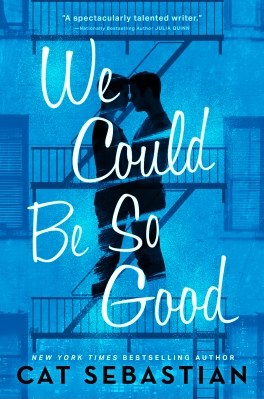
We Could Be So Good tells the story of Nick and Andy: two men who work together at a New York City newspaper, become friends and roommates, and slowly realize that they might also be in love. In today’s post, I’ll be exploring how the epilogue negotiates the characters’ uncertainty about their own future, the genre’s reassurance of the HEA, and the readers’ knowledge of how history shaped queer people’s lives in the years following the book’s conclusion. Here’s the cover and blurb:


Nick Russo has worked his way from a rough Brooklyn neighborhood to a reporting job at one of the city’s biggest newspapers. But the late 1950s are a hostile time for gay men, and Nick knows that he can’t let anyone into his life. He just never counted on meeting someone as impossible to say no to as Andy.
Andy Fleming’s newspaper-tycoon father wants him to take over the family business. Andy, though, has no intention of running the paper. He’s barely able to run his life—he’s never paid a bill on time, routinely gets lost on the way to work, and would rather gouge out his own eyes than deal with office politics. Andy agrees to work for a year in the newsroom, knowing he’ll make an ass of himself and hate every second of it.
Except, Nick Russo keeps rescuing Andy: showing him the ropes, tracking down his keys, freeing his tie when it gets stuck in the ancient filing cabinets. Their unlikely friendship soon sharpens into feelings they can’t deny. But what feels possible in secret—this fragile, tender thing between them—seems doomed in the light of day. Now Nick and Andy have to decide if, for the first time, they’re willing to fight.

Cover image, blurb, and content notes at the author’s website.

We Could Be So Good concludes with an epilogue. As it opens, Andy is about to get promoted at the newspaper his father owns, Nick is about to take a new job elsewhere to avoid a romantic conflict of interest, and they are about to start renovations on their apartment building. They’re throwing a party, their friends all gathered to celebrate these life milestones, and the story concludes on Andy’s musings about what might come next.  

It strikes him all at once – the collision of past and future he’s been experiencing over the past months. This place – this building, this apartment, their home – will be the place they lived when they were young. One day they’ll be somewhere else, and the things that are new and exciting now will be old and familiar then; they’ll learn to take for granted easy kisses and morning coffee. He can feel the wispy end of a filament that could stretch out to infinity, the end of a rope that reaches to an anchor at the bottom of the sea. For now he reaches for Nick’s hand.

While the epilogue takes place only a short time after the events of the main narrative, the final passage reassures readers about the permanence of Nick and Andy’s HEA. My favorite sentence has to be this one:  “This place – this building, this apartment, their home – will be the place they lived when they were young.” The sentence starts with a progression that puts an emphasis on the present, on what is right in front of the characters, with the demonstrative pronoun “this” (this place, this building, this apartment) and then closes it with a more permanent and stable possessive “their” (their home). The second half of the sentence executes a neat temporal reversal, showing us in the span of a few sentences how the future (“will be”) becomes the past (“when they were young”). The impression on the reader is of narrative omniscience and prescience. This passage is all about the narrator telling us that everything will be ok, that Nick and Andy will look back happily on this house as part of their shared past. 

In reading this passage, I thought a lot about a perennial favorite topic of debate for romance readers : whether there really is a functional difference between HEA (“happily ever after”) and HFN (“happy for now”). HFN, it is said, offers no permanent guarantees of the future. But is that really a meaningful distinction? The permanency of the future is never guaranteed, and even couples with the most solid commitment to the eternity of their love could meet an unexpected and untimely end. Of course, as romance readers, we claim the prerogative to eschew the unexpected and the untimely, and to believe that every couple we love lives out their days happy and together. On that count, too, the HEA/HFN distinction is perhaps irrelevant: as long as we’re always pretending couples stay together forever, what difference does the narrative’s chosen endpoint make? 

For my part, I have always held on to the idea of an HEA/HFN distinction, one that comes down to how characters articulate the permanence of their relationship to each other and to the reader. HEAs end with the characters pledging forever, and with narrative or stylistic reassurances of what the relationship will look like in the future. HFNs end with no promises, but with reminders to readers that love, even when it might not last, has no less value for its impermanence. 

What that distinction ultimately down boils to, I think, is how – and whether – the text decides to help the reader bridge the gap between where the story leaves off, and the present moment of reading. We are always projecting an imagined future into that gap, whenever we read romance. That act, however, takes on particular contours in queer historical romances like We Could Be So Good. In order to talk about that, I think it’s necessary to dig in a bit to the complicated question of how queer romance gets historicized. 

While I’ve seen adjectives like “fluffy” and “escapist” applied to Andy and Nick’s story, it’s also very deeply enmeshed in the realities of its period, from the sights and sounds of New York City in 1959 to the blackmail and arrest threats Nick faces as a closeted gay man reporting on police corruption. I get the sense that there’s been a gamut of reader reactions to the choice to include the menace of period-accurate homophobia, with some readers feeling that threats of outing loom too heavy over an otherwise lighthearted book, others arguing that the sense of threat is not prevalent enough to be “historically accurate,” and still others finding that the way the threat is posed but repeatedly thwarted in favor of plot-de-escalation feels like an appropriate balance, a protection of the characters. 

While all three of these individual reader responses are valid, from an analytical standpoint I’m more interested in how “period accuracy” within the text prompts the reader to think about its ending. The presence of historical realities in the text cannot help but raise, I think, the specter of future historical events that will shape Nick and Andy’s lives. The homophobia they face will not disappear after the last page of the narrative. Readers also know that, as New York City residents, the two men will bear witness to Stonewall, to the sea changes it brings, and to the AIDS epidemic. The idea that historical romance protagonists will face global upheavals that they cannot forsee, even though readers can, is not at all unique to queer romance. But I do sometimes suspect that queer HEAs are more heavily scrutinized by readers for historicity – more often read for signs of suffering and survival to come. Which, in turn, makes me wonder what strategies romance writers have found to push back, to carve out a sense of the future in the face of their readers’ knowledge of the past. 

A text that I found helpful as I tried to think through this question is the introduction to Jack Halberstam’s In A Queer Time And PlaceHalberstam argues, essentially, that there is such a thing as “queer time.” Threats to queer people’s safety and longevity have often meant finding different ways to think about time and the future. Yet Halberstam’s argument in fact goes quite a bit further than that. In A Queer Time suggests that the way society conceives of the very nature of time is deeply enmeshed with linear progression through social conventions like marriage, procreation, rites of passage within the nuclear family, legal inheritance: all structuring principles denied to queer people in various ways through history. In response to existing outside of heteronormative time frames, queer communities have created “alternative temporalities,” different ways of thinking about the future that “lie outside of those paradigmatic markers of life experience” (2). 

One of the most interesting examples of heteronormative organizations of time is what Halberstam calls “hypothetical temporality – the time of “what if”—that demands protection in the way of insurance policies, health care, and wills” (5). While literature or genre or HEAs aren’t directly under discussion here, I was struck by just how resonant this felt to me: that being denied shared access to “insurance policies, health care, and wills” as a means of securing the future means having to create new relationships to time. Halberstam’s notion of “queer time” means not just thinking about different possibilities for the future, but to think about time itself differently, and how it might be restructured against traditional hetero-temporalities. 

This is where I want to bring us back to that last passage of We Could Be So Good, because I think it’s juggling three different timelines simultaneously, in a way that resonates with the idea of alternative queer temporalities. There’s Andy’s time, which cannot access the future beyond the present moment. There’s the narrator’s time, which uses a 3rd-person semi-omniscience to report that the two men will live together long enough to look back on the current moment with fondness. And there’s the reader’s time, which has to bridge together Andy’s uncertainty with the narrator’s assurance, over the chasm of historical events we already know to have passed. With that in mind, I think we can see how the three final images bring together the ambiguity of reader’s time…

He can feel the wispy end of a filament that could stretch out to infinity

… the assured clarity of narrative time ….

the end of a rope that reaches to an anchor at the bottom of the sea

… and the hopeful uncertainty of characters’ time. 

For now he reaches for Nick’s hand.

That all three of these exist at once, moving beyond the dichotomous structure of HEA or HFN, speaks to what prose can do to create a sense of queer time in historical romance. 

In Conclusion Part 2: Even Though I Knew The End by C. L. Polk.

I’m back with Part 2 of “In Conclusion: A Four-Part Series on Epilogues and Endings in Queer Love Stories.” Before reading any of the individual close readings, I’d recommend checking out the introduction to the series here first. Part 1, on Something Spectacular by Alexis Hall, can be found here. Happy reading!

Even given that my corpus for this blog post series aims explicitly for eclecticism, the inclusion of Even Though I Knew The End probably merits some further discussion. It’s not marketed as a genre romance, and so unlike the three other books I’m looking at, there isn’t actually a promise of any kind of “traditional” HEA. It’s also set in the past, but in a fantasy version of the past with angels and demons and magic, and so some of the theoretical discussion about historicity doesn’t apply here. Still, I think this book warrants inclusion because it’s intimately engaged with the intersections between queer pasts and futures, and how the constraints of the past have their place in discussions of happy endings. 

A magical detective dives into the affairs of Chicago’s divine monsters to secure a future with the love of her life. This sapphic period piece will dazzle anyone looking for mystery, intrigue, romance, magic, or all of the above.
An exiled augur whose soul is due for Hell on Monday is offered one last job before serving an eternity in hell. When she turns it down, her client sweetens the pot by offering up the one payment she can’t resist―the chance to have a future where she grows old with the woman she loves.
To succeed, she is given three days to track down the White City Vampire, Chicago’s most notorious serial killer. If she fails, only hell and heartbreak await.

Cover image and blurb from the author’s website. CWs available in Emmalita’s review here.

In reading this book, I thought a lot about how it operates in a world of layered and interrelated constraints: the constraints of time, the constraints of religion, and the constraints of homophobia. The most evident of these is time. We learn quite early-on in the book that Helen has sold her soul to a demon to save her brother’s life, and is going to die soon because of it. While she briefly escapes this constraint, it returns as Helen sacrifices her soul to have 10 more years with Edith, the woman she loves. There’s a sense of perpetuity to this time constraint, one that collapses the beginning and ending of the narrative, bringing the past and present closer together in ways that will echo thematically through the book. 

The constraint of religion is a more unstable presence. There’s actually not much in the way of “organized” religion here, although churches and priests and prayers are mentioned. It’s more present in the fact that demons are real, as is the magic used to fight them. It’s also a pervasive presence in the habits and speech of the characters, which comes through in several arresting bits of prose: a face that moves through the “stations” of a reaction like stations of a cross, a clock that brings its hands together at midnight like “prayers.” Religion is both a threat and a tool to fight back against it, but its pervasiveness even into the language of the text cannot help, I think, but evoke for the modern reader the more concrete way that organized religion has, throughout history, constrained the lives of many on the margins, even as it proves a spiritual resource for others.  

That homophobia exists as a constraint on this world is mostly evident through the haunting traces it leaves on the text. We see homophobia in figures and images that feel absent or ghostly: the almost-empty building that Edith and Helen live in away from judging eyes; the past of the hidden queer bar that they drink in; the way the bar itself is hidden behind passwords and door guards; most horridly, the women in the Dunning Asylum, hidden in among the demonically possessed, being subjected to conversion therapy. 

Even Though I Knew The End is structured by various combinations of these three constraints – time, religion, homophobia. But it also shows us how, even though these constraints produce ghosts, they also leave space for joy. That’s especially clear in the final passage, where Helen realizes she’s going to have to cohabitate with her own ghost: the knowledge that she only has ten years to spend with Edith. 

Ten years. It wasn’t enough time, but I would live every blessed second of it. “We’re going to San Francisco.” 
She smiled up at me. “We’ll get a house in North Beach.” 
“Right away.” I said. “I’ve got the down payment and then some.” 
She sighed and pulled me close. “We’re going to be so happy.”
We would be. I’d dust the knickknacks, burn the sausage, wake up next to her every morning. I’d be grateful, even though I knew the end.

There are two types of time in this passage, both of them occurring as couples: present/future, and past/conditional. When Helen and Edith talk to each other, they use the present tense to describe their current circumstances (“I’ve got the down payment”) and the future to talk about what’s to come (“We’re going to be so happy/We’ll get a house”). In Helen’s interior monologue, the primary tense is the past (“She smiled up at me”) and to talk about the future she uses the conditional (“I’d dust the knickknacks”/“I’d be grateful”), though it’s somewhat disguised by the contraction of “I would” into “I’d.”

In English, as in many languages, grammatical rules dictate that when narrating in the past tense, we use conditional conjugations (“I would”/“I’d”) this way, to talk about the future. Which, when you think about it, is… not exactly intuitive?  I associate the conditional with uncertainty. In everyday speech, it’s mostly used for counterfactual hypotheticals (“If I won the lottery, I would buy even more books”), a chain of events that is at best uncertain, if not impossible. But the past tense, conversely, I think of as the tense of certainty. It’s the narration done by someone who has already reached the end of the story, who “knows the end” without internal ambiguity, and has decided how to tell it. The conditional within past narration has a bit of a ghostly function, a grammatical revenant that haunts the certain past with uncertainty about the future. 

And it’s used to beautiful effect here, alongside the much more optimistic combination of tenses that Helen and Edith use to talk to each other about their lives to come. On the one hand, the present and the optimistic future, with the confident linearity of the HEA; and on the other, the past, already destabilized by the uncertainty of the barely-disguised “I’d” conditional. Optimism, even when you know the end, and the end is going to hurt. 

That cohabitation of joy and pain, right up until the end, also helps, I think, to process the harshness of some of the constraints that characters live under in this book. As I wrote this piece, I was thinking a lot about something I was reading concurrently, a bit of academic literary theory recommended to me (by a very smart friend) called Feeling Backward by Heather Love. It’s a book that was challenging to read because its main thesis is somewhat antithetical to me as a queer romance reader. Love insists on the importance of looking back at texts from the past that dwell on feelings of queer shame, or failure, or loss, considering them not just as things to move beyond, but as something to sit with and remember. To preserve, even, from a risk of effacement that comes with increased mainstreaming of queer identities. She also invites readers to recognize these feelings’ persistence, even into a more accepting present: 

“It may in fact seem shaming to hold onto an identity that cannot be uncoupled from violence, suffering, and loss. I insist on the importance of clinging to ruined identities and to histories of injury. Resisting the call to gay normalization means refusing to write off the most vulnerable, the least presentable, and all the dead” (30). 

Love’s analysis is way more complex than I’ll be able to do justice to : a really sharp reading here points out that she’s neither dismissing optimism nor fetishizing marginality. And while ultimately I am still more drawn to the optimistic queer joy on offer in the endings of genre romance, Love’s work made me think about how to take in an ending like Even Though I Knew The End. A story of queer love that is explicitly haunted by ghosts – ghosts that maybe aren’t really dead – of homophobia and oppression. A “happy for now” ending that is desperately hopeful as it cohabitates – thematically, grammatically – with uncertainty and loss. I think what’s the most powerful is that despite all of the constraints that structure the novel, the two main characters end up living beside those constraints rather than being crushed under them. The entire theme of bodily possession and cohabitation with angels and demons and sprits gets turned into something that is, on some level, about queer experiences of time. And I loved seeing how this book used grammatical tools to infuse that interpretation into the prose as well as the structure of the novel. 

In Conclusion Part 1: Something Spectacular by Alexis Hall

Welcome to the first post in my “In Conclusion” series, looking at the final passages of queer love stories. If you haven’t read the introductory post yet, I would encourage you to do so, and then dive into the first reading: Something Spectacular by Alexis Hall. I’m glad this book comes first chronologically, because of the four I’ll be looking at, it’s the one that most directly engages with – quite literally fucks with – the “marriage and children” epilogue that scaffolds so many historical romance epilogues. Here’s the blurb: 

Peggy Delancey’s not at all ready to move on from her former flame, Arabella Tarleton. But Belle has her own plans for a love match, and she needs Peggy’s help to make those plans a reality. Still hung up on her feelings and unable to deny Belle what she wants, Peggy reluctantly agrees to help her woo the famous and flamboyant opera singer Orfeo.
She certainly doesn’t expect to find common ground with a celebrated soprano, but when Peggy and Orfeo meet, a whole new flame is ignited that she can’t ignore. Peggy finds an immediate kinship with Orfeo, who’s just as nonconforming as she is―and just as affected by their instant connection.
They’ve never been able to find their place in the world, but as the pair walks the line between friendship, flirtation, and something more, they may just find their place with each other.

Cover image, blurb, and content guidance available on the author’s website.

The final passage of this book takes the form of a letter from Orfeo to Peggy. One of the primary sources of conflict between them, prior to this letter, is their differing visions for the future. Peggy wants to buy a home, get married and have children, though she worries this would mean becoming a wife and a mother, neither of which fit her understanding of her own gender. Orfeo, for their part, wants to continue their career as a performer, traveling across Europe. While the locational elements of this conflict are solved by agreeing that love can survive periods of separation and long-distance, the question of having a child is logistically and legally more complicated. Any child Peggy would give birth to would not be biologically related to Orfeo, who is a castrato, and both know that “the world would not be kind to a child born out of wedlock.” The solution? For Peggy and Orfeo to marry, relying on society’s mis-apprehension of them as a man and woman, while conceiving said child – to be born, legally, in wedlock – with the help of a friend (and his partner). The scene before the letter describes the two couples procreating together in joyful detail. It is not just an act of pleasure, but an affirmation that family can be made through queer love and community, rather than legal and religious sanction of heterosexuality. 

Peggy talks about the creation of her and Orfeo’s child not just as an act of building a family, but as an act of building a different kind of future: theirs will be “a child who might, perhaps, have a child of their own who lived in a world where who you loved was not cause for speculation and who you were required no explanation.” One theoretical frame of reference against which we might look at how Something Spectacular is fucking with narratives about posterity is No Future by Lee Edelman. He talks about the idea of “reproductive futurism” : broadly, the way society uses The Child as the sacred image of the future, the center of all politics. In order to preserve “the privilege of heteronomativity,” society rejects any means of being and having sex – particularly queer ones – that don’t participate in child-making. Edelman suggests that rather than fighting against or working around the idea of queerness as antithetical to reproductive futurism, we might consider “accepting and even embracing” that negativity (10). As with any piece of theory, there have been all kinds of responses and rejoinders since No Future was published in 2004, including those that ask how reproductive technologies might shift this landscape. Something Spectacular’s detailed rendering of group sex as a “reproductive technology” made only of queer bodies in pleasure offers an interesting read that prods a bit at Edelman’s theory.

But what I found myself returning to while reading Something Spectacular is a more recent work of queer and trans theory: Grace E. Lavery’s Pleasure and Efficacy. She starts off by talking about the “romance of intractability” (xviii): how easy and seductive it is to believe that certain things – like “creating anew our own bodies, communities, and politics” (xxi)  – just aren’t possible. Against the romance of the intractable, Lavery celebrates technique, which she defines as “skills acquired through practice… with which feminists, queers, and trans people have made our lives not merely possible, but pleasurable” (xxiii). Technique can take a lot of forms, and Lavery’s work mostly focuses on techniques as they relate to gender transition. But more broadly the term refers to clever, crafty, and subversive ways that queer people have made pleasurable lives possible, even when they have seemed impossible. 

I really liked the idea of a romance novel giving its protagonists specific techniques to fight against the romance of the intractable. Something Spectacular offers a unique combination of techniques that are historically accurate (legal marriage, the social misapprehension of Orfeo and Peggy as man and wife), anachronistically futuristic (the language and understanding around queer identities) and sometimes both at once (group sex as metaphor for reproductive technology). But more broadly, I was struck by how this combination of techniques repositions the very nature of the HEA, making the ending of Orfeo and Peggy’s story something they build with technique rather than a structure to which they assimilate. 

If we look at the concluding letter that Orfeo writes to Peggy we can see two disparate HEA structures being evoked at the same time. One the one hand, there is the classic “we have a home in England and are married and have a child” structure : in short, the traditional historical epilogue. Orfeo evokes it in images throughout their letter, telling Peggy how they dream of “you and of home. Of grey English skies and green English fields,” of their child – “our stellina” who Orfeo humorously insists looked like a “disgruntled hedgehog” last time they beheld her. While we get little twinges of unconventional prose, what Orfeo dreams of is largely, prosaically, the material of a traditional HEA. A return to a genre norm. 

On the other hand, this novel’s epilogue also reminds readers of a more recent history of non-traditional HEAs, in which lovers might be living “distantly” from each other, or from the normative structures of marriage and family. That comes through best in the very final lines: 

Strange, I think I used to dream of stars, too, their distance and their pure light. I felt I belonged among them, like some cold, unreachable thing towards whom others could turn their covetous eyes. How fine it is, instead, to have a star of one’s own. Even a star who looks like a hedgehog. And a prince to cherish her with. 

All my love, always,
Orfeo 

This reads, at first, like a rejection of a non-traditional ending : the “stars” and “distance” and “light” which are the opposite of England’s grey skies and green fields get left behind with terms of refusal like “strange and “used to” and “instead of.” But what’s clever about this ending, I think, is that it isn’t really about a choice between two structures. Rather, this letter is full of technique. The first and most important, of course, is the adoption of a letter as form. It allows Orfeo to take control of their voice, an act which is particularly meaningful given how their patron economically controlled their livelihood by physically controlling their voice through the process of castration. Ending the novel on a letter’s signature reminds the reader of the central power of this voice-reclaiming. The letter allows Orfeo, as well, the technique of naming their child in their language (renaming being a powerful form of technique) in a way that preserves any positive associations with light and stardom: stellina. And finally, of course, the letter indicates to us that Orfeo has not, ultimately, had to choose between a “traditional” and “nontraditional” ending. Orfeo is still a star, they are still distant : not emotionally, nor in terms of community or place to belong, but quite literally and prosaically because they haven’t had to give up their career and are writing from across a physical distance. One that they control.

Ultimately, what works about this ending as a “queer marriage and babies HEA” is that the ending is not a structure into which the characters assimilate. It’s a series of active, productive techniques, whether that’s exploiting legal misgendering for the protection of marriage, the taking of physical pleasure in procreation with multiple queer bodies, the expansion of the configuration of family as they raise the child together, or the refusal to relinquish the tropes of distance, stardom, and light if they are chosen rather than imposed. It’s a nice doubling gesture that Orfeo gets the final word in fashioning this ending in their own voice, just as Something Spectacular writes its ending: using tradition not as a fixed point into which to assimilate, but a tool – a technique – for queering the future.

Thanks for reading. I’ll be back later this week with another post in this same series, this time a close reading of the ending of C. L. Polk’s Even Though I Knew The End. See you soon!

In Conclusion: A Four-Part Series on Epilogues and Endings in Queer Love Stories   

Photo by Kelly Sikkema on Unsplash

Today’s blog post is actually the introduction to a short series of close readings. I’m going to be looking at stylistic choices made at the ends of queer love stories, asking how these concluding moments work to imagine the future for their protagonists. This topic comes about mostly because of connections I’ve been seeing across a bunch of books in my recent reading. Over the last few months of consuming new releases and re-reading some old favorites, I came across many queer love stories with particularly moving or innovative conclusions. They included epilogues and quick final paragraphs; imagined both lives with marriage and babies, and families complete without either; expressed everything from firm optimism to tenuous hope. A lot of these endings, in all their glorious variety, served as a coda to pasts that were reimagined to be more welcoming to queer expression and identities, allowing characters to envision futures that might otherwise have been hard to see from their particular vantage points in history.

All of these endings got me thinking about how reading any HEA is, fundamentally, an act of inferring the future from information about the past. In queer romance, though, doing so means imagining optimism from not-always-hospitable spaces. It has also sometimes meant thinking around certain concluding structures integral to the genre – cohabitation, marriage, procreation – that haven’t always been accessible to queer protagonists. So as I often do, I started wondering about the particular prose demands of writing re-imagined pasts and imagined futures. What kind of work is done by the last sentences of queer love stories, the words that place a completed narrative into the past while opening up towards imagined futures? There’s a kind of temporal collapse between past and future to these endings that has, I think, particular valences for queer love stories – even if they share a lot of terrain with the wider genre they belong in. Endings ask us to look closely at the spaces between the conclusion of the narrative and the epilogue, between the characters’ past and their future, between the past as the author has imagined it and the past as the reader knows it (or thinks they know it), between the future the reader lives in and the future they imagine the characters living. And as I’ve read, I’ve been struck by the variety – in both style and structure – with which authors approach these questions of temporality for their characters. 

While there are plenty of queer historical romances with traditional epilogues that would allow me to think through these questions, the books that appealed to me on the broader topic of queer futures included both narratives that aren’t aren’t historicals (though they’re interested in the political relationship between the past and the future) or that aren’t genre romances (though they include love stories that end on a note of optimism). So while I started off wanting to write specifically about histrom epilogues, this project quickly expanded to include different sorts of books. That expansion also had some consequences for format. Rather than one long blog post, I’m going to share four separate posts about four different books over the span of the next few weeks. One reason for doing so is that I want this discussion to be accessible to readers who prefer to avoid spoilers: expecting everyone to have read four different recent releases in order to engage with a single post was… well, even for someone accustomed to writing for a niche audience, that seemed comically limiting. This way, readers can pick and choose which pieces they want to read. I will do my best not give away too much about other books’ endings across posts, though I will try to draw broader connections here and there, finishing up with a quick conclusion after the final close reading. 

Another benefit of this format, for me, is that I simply had too much to say about every book, and no way to cope with all the various connections and differences between them, to confine myself to a single coherent piece. As different as they are, I think the books I’ll be looking at fit together in part because of how differently they approach central question of imagining queer futures, and the diverse kinds of queer identities the protagonists have. I think – I hope – the expansiveness of the project will ultimately be one of the takeaways.

On that note, I will also be trying to incorporate just a tiny bit of queer literary theory into each of my readings (I promise it won’t hurt!). While reading romance has turned out to be integral to exploring and understanding my relationship to my own queerness, I am all the more conscious of the ways in which my experiences as a cis white woman differ from the variety of identities represented in these books. My hope is that thinking with a range of scholars will help me more sensitively attune to the intersections at play in these texts, while still fully owning the limitations of my own perspective. I also want to acknowledge that in limiting myself to four books, I am also by necessity limiting the full range of intersectional identities that could be discussed from across queer romance: I will try, in my concluding post, to recommend more novels for further reading and draw some broader conclusions.

So, all that said, let’s talk books! I’ll be looking at the final passage of four novels, ordered chronologically by the era they’re set in. I’m going to start off discussing structural techniques for radically queering the traditional historical epilogue in Something Spectacular by Alexis Hall, a Regency-era romance. Then – in a departure from both genre romance and epilogues – we’ll talk about magic-inflected history and living with the ghosts of queer pasts in Even Though I Knew The End, set in C.L. Polk’s imagined 1930s Chicago. Then I’ll take on We Could Be So Good by Cat Sebastian, a 1950s-set romance that builds gentle bridges over the years of queer history that sit between the epilogue and the readers’ present. And finally I’ll look at a contemporary romance with a radical political vision for a future led by its young Latine protagonists: Ander and Santi Were Here by Jonny Garza Villa. 

I hope you’ll join me over the next two weeks, reading whatever speaks to you, and sharing any thoughts and recommendations if you’re so moved! 

The Mechanics of Making Me Cry: The ‘Low Moment’ in Something Wild and Wonderful by Anita Kelly.

Photo by Sébastien Goldberg on Unsplash

Today’s blog post is about Anita Kelly’s Something Wild and Wonderful. More specifically, it’s about the novel’s low moment. I don’t often analyze passages this close to the end of a book, and so I’m going to flag this up front for spoilers. If you haven’t read Something Wild and Wonderful yet: GO, read it now, and you can come back and read this post later. If you have read it, I want to get into exactly what makes the low moment of this book one of the most poignant, tear-jerking, yet hopeful things you’re likely ever to read. But first, here’s the cover and the blurb. 

Alexei Lebedev’s journey on the Pacific Crest Trail began with a single snake. And it was angling for the hot stranger who seemed to have appeared out of thin air. Lex was prepared for rattlesnakes, blisters, and months of solitude. What he wasn’t prepared for was Ben Caravalho. But somehow—on a 2,500-mile trail—Alexei keeps running into the outgoing and charismatic hiker with golden-brown eyes, again and again. It might be coincidence. Then again, maybe there’s a reason the trail keeps bringing them together . . .

Ben has made his fair share of bad decisions, and almost all of them involved beautiful men. And yet there’s something about the gorgeous and quietly nerdy Alexei that Ben can’t just walk away from. Surely a bad decision can’t be this cute and smart. And there are worse things than falling in love during the biggest adventure of your life. But when their plans for the future are turned upside down, Ben and Alexei begin to wonder if it’s possible to hold on to something this wild and wonderful.

Cover image and blurb via the author’s website, where you can also find a list of content warnings for the book.

Ok. If you’ve read this far, that means either you don’t care about spoilers, or you’ve already read this book, and you know that the low moment of the story takes place when Ben and Alexei – who have fallen in love hiking the Pacific Crest Trail – have split up. Alexei has returned to the PCT alone, and the two are writing each other letters. There are 16 letters in this three-chapter epistolary section, written over a period of around two months. Ben writes six letters, all to Alexei, but sends only one of them. Alexei writes to Ben, to his sister, and to his Mom and Dad, both together and separately, for a total of 10 letters, of which he sends six. What I think makes these letters work so well is how they’re thematically related to the rest of the narrative, while still offering a critical shift – stylistically and emotionally – for the reader. So that’s what I’ll be looking at today!

“I just wanted to write it down” :  setting up the low moment.

The first few chapters of the book foreshadow the importance of the epistolary low moment. From very early on, for example, we see that Alexei isn’t much of a talker. Many of his earliest exchanges with Ben happen in single-word exclamations (“Sinks!”) over things they’re excited to see on days off the trail. And even as the two men get closer, they often emphasize how much they appreciate each other’s quiet. There’s a real attention drawn to the choice of when and how to communicate, which makes the eventual decision to have the low moment communicated through letters feel more grounded. 

The early parts of the story also underline the value of written communication. This is less the case for Ben, who is a voluble and easy talker, but even he does a fair amount of texting family and friends while he’s on the trail. Alexei, on the other hand, uses a journal, which we learn serves several purposes. One is to let him process his feelings silently- at one point he remarks of his journal that he “considered pen and paper talking. Words were involved. It counted.” More importantly, though, writing in his journal is a form of grief processing, as Alexei tries to grapple with the experience of estrangement from his homophobic family. In a particularly poignant scene, Alexei realizes he’s not going to be able to sleep until he writes down a question for his parents :

Maybe if he wrote the one thing – not a bullet point, but the words that lived inside him every minute – he could finally sleep. 
He lifted his pen once more. 

Do they miss me? 

Alexei stared at the words, barely visible. 
No. Not quite right. 
There was a reason he wanted to write this, finally, today. 
Alexei chewed the cap of his pen. He listened to Ben breathing. And then he fixed the question, made it closer to what his heart wanted to know. 

Does it count if the person they miss isn’t actually me? 

The way Alexei works on this sentence, iterating it until he gets it right, familiarizes the reader with writing as a way of processing emotion. Doing so early on is part of what lets his later letters – and their iterative style- feel like a natural way for Alexei to process his greif over possibly losing Ben. 

“I finally have things I want to say to you now”: writing through change, changing through writing. 

As expertly as the novel uses these letters to extend Ben and Alexei’s prior communication, the epistolary low moment also feels stylistically and formally set-apart. Often, when low moments fall short for me, it’s because they don’t show enough internal growth convince readers of the HEA. In the case of these letters, not only do we have two full months to see how Alexei and Ben have reflected and healed and changed, but we also get to feel that change through subtle stylistic shifts.  

Perhaps the most obvious way these letters stand out is their switch from third person to first person POV.  I don’t think that either POV is inherently more emotional or proximal to character: executed well, both first and third can be equally impactful. But something about the switch from “he” to “I” does draw the reader’s attention, indicating an altered depth and intimacy. I think it’s also worth mentioning that letters, in particular, use the past tense for actions (“I hitched here to Tahoe City with a woman named Jenn”) and the present tense for emotions (“It finally feels like the PCT is my desire line”) which underlines the immediacy of both men’s feelings. 

Letters also allow for a slightly different structuring of their first-person prose, particularly compared to conversational dialogue (the only other the instance in the book where first-person is used significantly). While conversation in novels is considerably more polished than in real life, novelistic dialogue still needs to sound plausibly oral. No such stricture applies to letters, which can be self-consciously structured while holding on to the intimacy of the first person. There are so many stunning passages, and even single lines, in these letters, and part of what makes them work is that they can have a bit more deliberate prose structure to them. Take the example of this line, in a letter from Ben about Alexei’s visit to his family, that encapsulates the conscious stylistic reflection of the epistolary form: 

I wish I had better words to say about all of it. And I’m not going to send this letter, either—I’m sorry I can’t make myself write a real letter to you; I can’t exactly explain it, but I’m still trying to be careful with my heart here, I still want to keep it intact from now on—but I just wanted to write it down. That I’m sorry. I’m sorry if being here was hard for you in any way. I’m so sorry your family left you, Lex. And I’m sorry I didn’t make it more clear. That my family would never replace yours. But they would’ve been yours, too. There are so many ways to find family.

The Caravalhos loved you, Lex. Some of them always will.

The first thing I love about this passage is how it shows Ben reflecting on the action of writing, while producing a complex and layered sentence that could probably only reasonably occur in written from:

And I’m not going to send this letter, either—I’m sorry I can’t make myself write a real letter to you; I can’t exactly explain it, but I’m still trying to be careful with my heart here, I still want to keep it intact from now on—but I just wanted to write it down. 

Not only does writing about letter-writing draw the reader’s eye to what makes this section unique, it also emphasizes the importance of self-reflexion during the low moment. Ben’s longer-than-usual sentence about writing here is thus doubly impactful: it both tells and shows us how he’s taking more time to reflect and process his emotions. 

The second half of the passage, though, is where things get really emotional. There’s a strong cadence to Ben’s variations on the central theme of regret: “That I’m sorry”/“I’m sorry if”/“I’m so sorry”/“And I’m sorry.” After that, the sentence fragments start to build on each other, to depend on each other, echoing the theme of a broken heart mending into more wholeness: 

I just wanted to write it down. That I’m sorry.

And I’m sorry I didn’t make it more clear. That my family would never replace yours.

The Caravalhos loved you, Lex. Some of them always will.

While these fragments are stunningly rhythmic in their own right, I think what they do best is provide a contrast to allow certain single, full sentences to stand out. At the end of this passage, that’s the case for “There are so many ways to find family,” which – unlike other sentences in the paragraph- isn’t part of any repetition, referentiality, or juxtaposition. That this sentence can stand on its own outside of the passage reinforces its centrality. 

“I keep hoping you’ll write me again”: reading unsent letters as witness.

Alongside their unique prose, one of the most impactful features of these letters is that some of them are marked, at the end, as unsent. The “unsent” tag serves several narrative purposes. In Ben’s letters to Alexei, it shows how Ben is guarding himself from heartbreak, working on the careful processing of feelings. In the case of Alexei’s letters to his parents, leaving them unsent allows Alexei closure without suggesting that he needs to ask for forgiveness or reconciliation in order to have it. 

Beyond the reasons specific to individual characters, though, there’s still something deeply impactful about these unsent letters. Unsent letters are almost inherently melancholy, allowing readers on several occasions to reach the end of a heart-rending confession only to see that it was never read by its intended recipient. But I’m also intrigued by how the unsent letters between Ben and Alexei position the reader as a witness to their romance.

I think the best way to demonstrate this reader positioning is by considering one pair of letters. One is from Ben to Alexei, the other from Alexei to Ben, both are written on July 8th. That’s the only time two people write each other a letter on the same day, and it includes Alexei’s only unsent letter to Ben.

What struck me in looking at this pair of same-day unsent letters is how similar they are. Up until this point, Alexei and Ben’s letters have been fairly divergent. Alexei’s are lyrical and full of yearning; Ben’s one letter thus far has been angry and confused, full of short, clipped sentences. On July 8th, though, both men seem to be drawing closer to each other without realizing it. Take these two passages: 

“I miss it, Lex. I think that’s part of what’s been hurting so much. You left me, like I probably always knew you would, but… you got to go back. 
I lost you. But I lost the trail, too.” 

“I’m so tired, Ben. 
What if I die out here?
I don’t want to die out here. 
I feel so far from God. 

It’s made me realize how, even though we never really talked about my faith, you and me, how close I felt to it, while we were together. Like God had been hovering over me the whole time saying See? This is love. Like I love you. Do you understand?

I love how these passages open so similarly, with a three-word sentence, a comma, and direct address. They’re also thematically related. Both men are grappling with the loss of a spiritual experience: the trail, for Ben; his faith, for Alexei. They also both, rather poignantly, seem to associate that spiritual experience with their partner. The manner of expressing this loss differs – Alexei recalls the presence of faith with Ben; Ben laments the absence of the trail with the loss of Alexei – but from opposite directions they’re both writing the same emotional experiences. 

That, in itself, is poignant. It gives the reader hope for their reconciliation, how similar their grief is, even when they’re in opposition to each other. Reading how they work through these similar feelings, unbeknownst to each other, also puts the reader in a privileged space of witness. As the only ones who can see these subtle parallels, we’re asked do a bit of work that the characters’ can’t yet do: to process some of these feelings in their stead, waiting for the moment where they can do so together. I think it’s why reading this segment feels like a privilege, to me. Readers get to not only bear witness to emotion, but also to play an active role in its decoding. It’s a perfect distillation of why and how low moments work, and why I think this is truly one of the best-written low moments in romance. If you’ve made it this far and still haven’t read this book, I cannot recommend it highly enough. 

Close Reading Snapshot: Emily Wilde’s Encyclopaedia of Faeries

Photo by Aaron Burden on Unsplash

Hello and welcome to the first Close Reading Romance* post of the new year: a snapshot look at Heather Fawcett’s Emily Wilde’s Encyclopaedia of Faeries. Why the asterisk? Well, the book I’m looking at today isn’t exactly a genre romance. It’s a fantasy novel with a lovely little romance plot running through it, but I’ve been seeing it discussed and enjoyed in a lot of my online romance spaces. So that little disclaimer is how I’m going to justify writing about it here, because it’s either that or rename the blog “Close Reading Genre Fiction with Strong Romantic Elements” and while the blog periodically heads off in that direction, it doesn’t exactly roll off the tongue. 

My strongest impression from reading this book was the vividness of its sense of place: it’s set on the fictional nordic island of Ljosland, where Emily Wilde has come to research local faeries for the encyclopedia she’s compiling. The setting is deeply evocative, and the book remains compulsively readable despite long scenic descriptions in relatively dense prose. That’s what I’ll be looking at in this “snapshot” post: how Emily Wilde uses thickly descriptive prose to create a feeling of estrangement- one that’s suspenseful and eerie and invigorating for the reader, rather than distancing or alienating.

A quick note before I begin: these “snapshot” posts are meant for folks who haven’t yet read a book, so you can get a sense if the prose style is likely to appeal to you. The spoiler level on this post is thus rather mild, though I do allude to something important we learn about one of the protagonists by around the 25% mark. Proceed, or don’t, accordingly! 

Here’s the cover and blurb: 

Cambridge professor Emily Wilde is good at many things: She is the foremost expert on the study of faeries. She is a genius scholar and a meticulous researcher who is writing the world’s first encyclopaedia of faerie lore. But Emily Wilde is not good at people. She could never make small talk at a party–or even get invited to one. And she prefers the company of her books, her dog, Shadow, and the Fair Folk to other people.
So when she arrives in the hardscrabble village of Hrafnsvik, Emily has no intention of befriending the gruff townsfolk. Nor does she care to spend time with another new arrival: her dashing and insufferably handsome academic rival Wendell Bambleby, who manages to charm the townsfolk, get in the middle of Emily’s research, and utterly confound and frustrate her.
But as Emily gets closer and closer to uncovering the secrets of the Hidden Ones–the most elusive of all faeries–lurking in the shadowy forest outside the town, she also finds herself on the trail of another mystery: Who is Wendell Bambleby, and what does he really want? To find the answer, she’ll have to unlock the greatest mystery of all–her own heart.

Cover image via the publisher (with thanks for the high-res image and ARC). Blurb via Goodreads. For CWs, see Leigh’s always-helpful list here.

Let’s start with a look at two of my favorite wintry-nature descriptions of the book. These give a sense for the prose, and a chance to talk about why I think “estrangement” is an unlikely but useful word to describe the work Emily’s nature descriptions do. 

The mountains themselves were lightly ensnowed, though there was no threat of a sequel in that cerulean canopy. Within the hinterlands of the prospect heaved the great beast of the sea with its patchy pelt of ice floes. 

The afternoon held the sort of borrowed, ephemeral warmth that interrupts the advance of winter sometimes, and I found myself wondering what summer was like in this place. 

So, why estrangement? Well, to begin, one thing I love about the prose in the book is how much it tells us about Emily Wilde as a character. She’s a scholar, she’s very prickly (I love her), and in particular, she doesn’t enjoy having out-loud, public feelings. You can see in these passages, which putatively belong to her academic journal, how she hides both her feelings and herself behind flowery and overly-ornate prose. Saying “there was no threat of a sequel in that cerulean canopy” instead of “the sky was blue, so it probably wouldn’t snow again” arguably tells you more about the character writing than it does the sky. In this case, it mostly tells us about how Emily wields estrangement – from her listener, from her own feelings – like a literary weapon. 

But I also think that “estrangement” applies to how the prose makes the reader feel about the setting. Ljosland is meant to be a strange and somewhat forbidding place, and the use of complex terms like “cerulean canopy” or “ephemeral warmth” alongside the full-cloth invention of words like “ensnowed,” give the reader a sense of the harshness, and the strangeness of the environment. 

Another thing that makes the landscapes seem strange – and maybe even a little unsettling- is how the prose imbues them with movement. In the first passage, the use of the word “prospect,” which can mean both “the possibility of a future event occurring” as well as “an extensive view of a landscape” makes the sentence feel like it’s moving with shifting meanings, even before we’re told the water moves like an animal with “its patchy pelt of ice floes.” In the second passage, we can see how the life within the landscape – its surprising moments of warmth – prompts feelings-averse Emily to muse wistfully about other seasons. There’s movement in the prose, and glimpses of how the settings move Emily emotionally.

Part of what I think prose work like this can do is “train” readers, even unconsciously, to have heightened emotional reactions to certain metaphors and techniques when they’re deployed at important moments of the text. Below is just one such moment, where the experience of estrangement – both around natural settings and around Emily’s emotions – comes to the forefront of the text. It’s a moment where Emily describes Wendell, her colleague, her rival, and (as it turns out) a part-faerie prince who has been deposed from his realm. He’s using mirrors to show himself images of the landscape that he’s been exiled from for most of his life:

After we ate, I watched him play with the mirrors. When he touched them, strange things appeared- for an instant, I saw a green forest reflected back at me, boughs swaying. I blinked and it was gone, but some of its greenness lingered around the edges of the glass, as if a forest still lurked somewhere beyond the frame. 

“Are those the trees you would see in your kingdom?” I asked. 

He let out his breath and drew his hand away. “No,” he said quietly. “That was merely a shadow of my world.”

I gazed at him a moment longer. His mourning was a tangible thing that hung in the air. I have never loved a place like he has, and felt its absence as I would a friend’s. But for a moment, I wished I had, and felt this as its own loss.

Having established how alive the landscapes of Ljosland can be, the text is better able to underline the poignancy of Wendell only being able to see his home reflected, as in a mirror. I also love how we see Emily’s estranged forms of speech crack, just a little bit, under the weight of her emotions towards Wendell. She still makes readers work for her meaning: I can almost feel the spaces around the missing words in the fragment “felt its absence as I would [feel] a friend’s [absence].” “Feel” and “absence” being, well, absent from the sentence allows it to echo with loss, but I find it really beautiful how Emily is able to relate to Wendell’s homesickness by feeling the absence of what she doesn’t understand. It’s a gorgeous passage, and one that gains in depth because of how, as readers, we’ve already been trained to experience the estrangement of Emily’s writing, and the movement of her settings. 

If this kind of dense, slightly-enchanted prose appeals to you, I would certainly recommend Emily Wilde’s Encyclopaedia of Faeries. Since I finished it, I’ve been missing it not like I miss a book, but like I miss a place. And I think this quick look at the prose has helped me understand a little bit better why that is. If you pick it up, I hope you enjoy it as much as I did! 

Embodied Vocabularies: Words and Touch in Charlotte Stein’s Sweet Agony

Photo by Anna Zakharova on Unsplash

Hello! It’s been a little while. But I’m back, returning to a short novel I read during the early days of lockdown: Charlotte Stein’s Sweet Agony. Its vivid imagery and the unique way the main characters describe their world have stuck with me in the intervening years. This is a high-heat erotic romance between a reclusive touch-averse hero, and the woman who responds to his advert in the paper for a housekeeper, getting more than she bargained for. It’s also a really vivid exploration of the eroticism of words, both written and spoken, which makes it particularly open to the joys of close reading. Here’s the cover and blurb. 

New job, new boss, and he’s cold, strict, but terribly attractive. Does Molly Parker stay or does she go? Because beneath Cyrian’s chilly front, there may be a heat that’ll burn her up.

Giving in was vicious bliss.

The live-in position is an opportunity for Molly to earn and escape a problematic family. There’s just one drawback. Her employer is the most eccentric, aloof and closed-off man she’s ever encountered. His rules are bizarre and his needs even more so, and caring for his ramshackle Dickensian home is far more than she ever bargained for. Only their increasingly intense conversations stop her heading for the door. Cyrian Harcroft is a man of many mysteries and secrets, and the more she learns the greedier she is for each and every one. Especially when she discovers his greatest fear: any kind of physical contact. Now all she has to do is dig a little deeper, to unearth the passion she knows he can feel…

Cover image and blurb via Goodreads. CWs at Leigh’s review here.

The opening two chapters of this book offer a fresh take on a common trope: opposition that attracts. In the case of our hero and heroine – Cyrian and Molly – it’s not so much a case of having opposite personalities, because they are, in fact, very similar people. Instead, the opposition is technical. Through opposing sets of metaphors and stylistic approaches, Molly and Cyrian come into the reader’s world in very different ways. 

Molly inhabits the text in ways that focus on physicality: not just descriptions of her body (though those are there), but also in her technique of imbuing everything she sees and hears and experiences with a human form. We first get a glimpse of both her vivid imagination, and her tendency to give bodily shape to feelings, moods, and inanimate objects, as she contemplates Cyrian’s house. She describes it as a “bad tooth in a mouth of pristine white ones” and, later, as having windows like “blank, black eyes” that she can “almost feel… pressing into [her] body.” Right off the bat, even though she’s just looking at a rundown house, we get a sense that Molly longs for physical closeness, and seeks it by imagining the embodiment of things around her.

In contrast, for the first two chapters, Cyrian appears only as a voice. At first, the circumstances of his physical absence seem fairly mundane. Molly knocks on his door, and he tries to dismiss her, claiming he no longer seeks responses to his advertisement. Her active imagination and tendency towards chattiness draw him in, however, and they spend the majority of the first chapter bantering from across a closed door. Even after he invites her in, he hides whenever he speaks to her, and it takes several chapters before he allows himself to be seen in her presence. 

In response to Cyrian’s disappearing act, Molly starts off with her usual attempts to accord a bodily form to disembodied things. The metaphors she uses are increasingly vivid, as if she knows she has to work harder to find a body for the sounds made by a man who won’t let his own be shown. She starts with his laugh, and doesn’t seem to struggle to imagine exactly what kind of privileged, assured embodiment Cyrian’s laughter would take: 

You could stick that awful noice in the House of Lords and have it shout at the Prime Minister. It could attend a swanky soiree entirely independent of the person it comes out of, and no one would blink an eye

Things change when he begins to speak however, in a way that allows us to learn a bit more about Molly’s relationship to physicality, and why her role in this book isn’t as simple as a woman who teaches a touch-averse man to inhabit his body more comfortably. 

One thing we learn about Molly early on is that she has lived a fairly isolated life, keeping company with books. As a result, she feels a great deal of comfort with words on the page, but has comparatively little experience with words spoken by a person. This tension destabilizes her tendency to give physical form to things: she has to let go of the kind of words that feel familiar- words manifested physically on pages of books- in order to explore the kinds of words she’s always longed for – spoken words that have no physical form, but rely on a body in proximity to hers in order to be experienced. This paradox of embodiment/disembodiment comes to a head in what is probably my favorite passage of the book, when Molly first hears Cyrian speak: 

He uses the sorts of words I’ve waited all my life to hear spoken aloud- words I barely know how to pronounce because the only time I’ve ever encountered them has been in books. I had no idea that ‘reprobate’ curled that way, or that ‘disillusion’ sounded so small to begin with and then so big at the end. Though, granted, part of that might be down to the way he talks. His tongue practically makes love to each syllable. I feel like his sentence should smoke a cigarette, directly after the full stop. 

This passage pays gorgeous tribute to those of us who learned words by reading them first, long before we ever heard what they sounded like. It also contains a perfect example of Molly’s efforts to grant physicality to everything around her, as she imagines Cyrian’s sentence smoking a cigarette in an embodied, deeply eroticized metaphor. What interests me the most here, though, is not so much the metaphorical specificity as the moments of vagueness in the passage. Molly tells us that reprobate curls “like that” and that disillusion sounds “so small” and then “so big” without indicating the scale or scope of her measurement. I don’t think this is an oversight or a failure of specificity (just a moment ago, Molly was able to tell us Cyrian’s laugh could shout at the PM in the House of Lords). Rather, these words hold a place within the text for sentiments and experiences that inevitably escape the written word. 

Even when Molly gets more specific about Cyrian’s voice, later on, she does so in a way that remains evocative yet – curiously – just a bit inaccessible to the reader. Of his pronunciation of the word “reprobate,” Molly tells Cyrian “You turned the letter R into Beethoven’s Fifth Symphony. People will probably be playing that letter O at funerals.” This comparison is beautiful, but it’s also noticeably hyperbolic: so much so that it precludes concrete comparison. Even if readers say the word “reprobate” out loud, we are unlikely to actually hear the symphony that Molly hears. This heightened, exaggerated comparison reinforces, as a reading experience, the point that Molly is trying to make about her connection to Cyrian: it’s powerful because it cannot be encoded into the printed texts she’s used to consuming. Cyrian’s words escape familiar physical forms and rely on presence: a body in proximity to another. 

At its most elemental level, this passage offers a new way to think about words and physicality, which in and of itself is valuable (and beautifully rendered in the text). But I also think that there’s important resonance here for Molly and Cyrian’s character arcs in the rest of the book. Sweet Agony is an erotic romance, between a woman who craves the comfort of physical connection and a man who needs to develop trust before he is comfortable being seen or touched. This aspect of the relationship is negotiated through discovery of what kinds of bodily contact they do – and do not – have with each other. On that interpretative level, Cyrian sets most of the boundaries and defines the limits of their physical relationship, while Molly provides the understanding he needs to do so. As such, Cyrian appears to go through the more active change of the two protagonists. We see him move from fearing Molly’s proximity, to feeling safe enough to admit his desire for her touch. While it’s a rewarding and emotionally moving storyline, it also appears a bit unidirectional, if the parameters of “comfort with physical contact” are the primary consideration.  

I think it’s worth watching the text, though, for Molly’s own evolution away from her insecurities. This evolution is perhaps a bit more subtle, because it happens through her relationship to words rather than to touch. Just as Cyrian takes tentative steps to allow closer and closer physical proximity, Molly also becomes more and more comfortable experiencing words in their embodied form: a change which is aided by Cyrian’s careful understanding. In the early days of their relationship, Cyrian communicates with Molly mostly through letters, and readers can see her joy and her comfort in the physical word-forms familiar to her from reading books: the “fancy swirling script” and “beautiful envelopes and little cream cards” with wax and a seal. Slowly but surely, though, she takes steps towards Cyrian as he leaves her books to read, and then reads reads books to her aloud, before finally she is able to hear him voice fantasies that they can share.  All of this renders their relationship a negotiation of partners, and Cyrian does equal narrative work to help Molly move towards the kind of embodied words she was denied all her life.

Taking into account both the physical and the verbal, Sweet Agony much more clearly becomes a book where the characters meet each other halfway, and where words are just as erotic, and just as important, as touch. The early passages around Molly and Cyrian’s meeting draw the readers eye there, and attune their ears, and make the rest of the reading experience all the richer.